“ADA-Compliant” That Still Doesn’t Work
Series: Almost Accessible
This piece is part of the ongoing Almost Accessible series, where I name the quiet ways systems filter people out — not because anyone stood at the door and said “no,” but because the structure was built with someone else in mind. You can read more about the series on this page.
It wasn’t rage. It was annoyance. The kind that comes from encountering something that almost works and still doesn’t. The kind that makes you look around the room and think, someone stood here with a tape measure and believed this was finished.
I was working in an historic building that had just undergone an all-new buildout. New walls, fresh finishes, updated fixtures, carefully selected materials — the kind of renovation that makes everyone feel proud of having “done it right.” I was told more than once that it was fully ADA-compliant, and I have no doubt that it passed inspection.
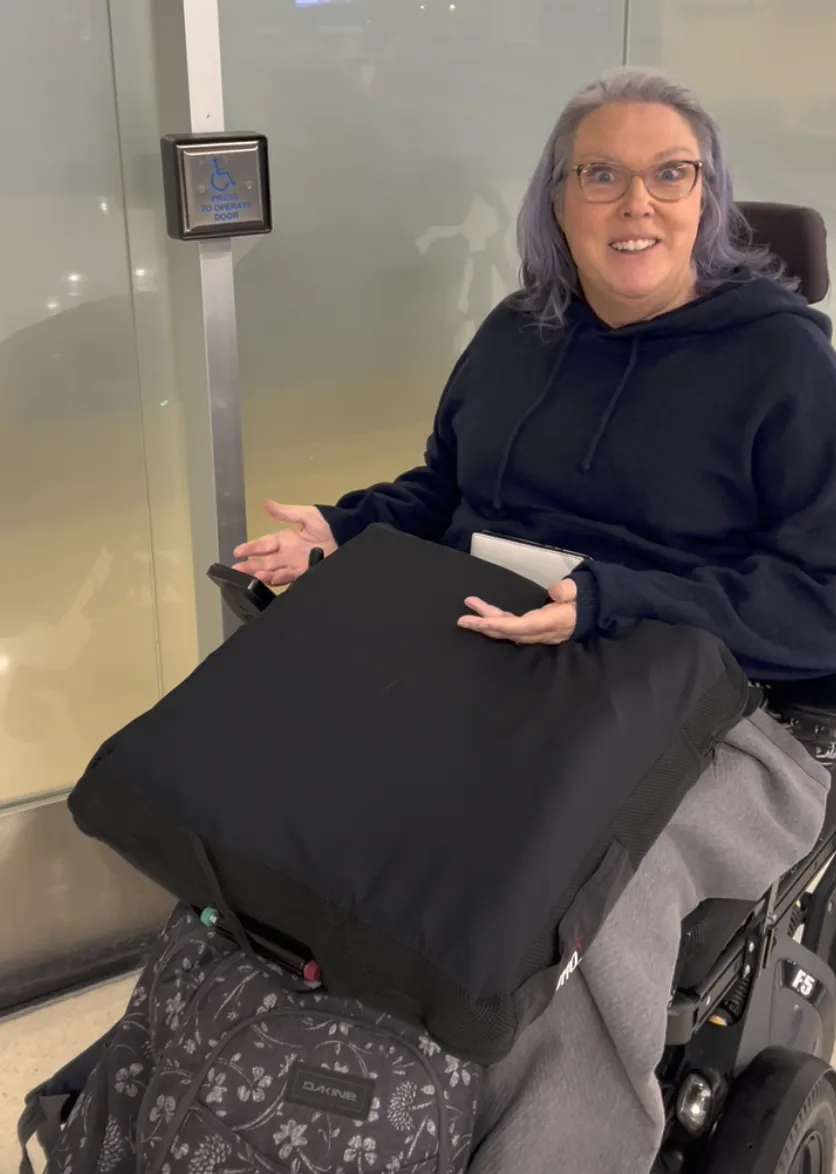
The entry to the space that held my office, a half-dozen other offices, and a large lab had been fitted with a powered door with a push-button. Knowing myself and my cohort, I noticed it immediately. That detail matters. It signals intention. However, the button had been mounted at 48 inches off the ground. Forty-eight inches happens to be the maximum allowable forward reach height under federal accessibility guidelines. It passes. It is defensible. It meets the requirement.
It is also about a foot higher than most power wheelchair users can comfortably and repeatedly access without strain. I actually told the worker, “My service dog should be able to hit that button without standing on the back of another service dog.” He defended his actions by cited the requirements and said it would not be moved to satisfy me.
Could I could press it? Yes, but only by raising my power wheelchair’s seat to its full height and leaning in a way that was neither smooth nor stable. Once, that’s manageable. Over the course of a full workday, it becomes effort. By the end of the week, it becomes fatigue — the kind that doesn’t show up on a drawing set but absolutely shows up in a body.
The large multi-stall restrooms had clearly been designed with measurements in mind. In the ADA stall, there was turning radius and there were grab bars. The sink clearance appeared correct. Everything looked compliant. When I went to leave, I discovered that the door closer had been set so tight that I could not open it independently.
I repositioned. I braced. I tried again. The pull force required to open the door exceeded what I had available in my arms that day. Not theoretically. Not by interpretation. In my actual body, in that actual space, I could not get out.
I was able to leave after calling a friend who had an office on the other end of the hall. I heard him sprinting, as his footfalls landed on the polished concrete floor, and when he reached me he was winded. He said he was worried that I’d fallen. Thankfully I hadn’t. But it emotionally jarring for both of us.
Think about this. I was working in the building, and I needed assistance to exit a restroom that had just been renovated to meet accessibility standards.
This wasn’t a historic structure with limitations. It wasn’t a retrofit compromised by old walls or narrow corridors. Every dimension had just been chosen. The height of the button was selected. The tension on the door closer was set. And each of those decisions landed precisely at the outer edge of what the law allows.
Minimums are not the same thing as usability.
When accessibility is treated as a checklist, the goal becomes passing inspection rather than inhabiting the space in a real body. You end up with environments that technically allow entry while quietly increasing effort — or, in moments like that one, temporarily removing independence altogether.
“ADA-compliant” is often said as reassurance. Sometimes it’s said as defense. As though meeting the letter of the law settles the matter. But the law establishes a floor. It does not guarantee ease. It does not guarantee independence. It certainly does not guarantee dignity.
I don’t need perfection. I don’t need special treatment. I need a space that works without negotiation — a button placed where it can be used comfortably, a door closer’s tension set to allow it to be opened without requiring a second person.
If a brand-new buildout can meet every requirement and still leave someone stuck inside a restroom, then the conversation cannot end at compliance.
Because something can be technically accessible and still not function. And if we stop at “it passed,” we miss the whole point.
Almost accessible doesn’t look broken. It just works exactly as intended, and that’s the problem.