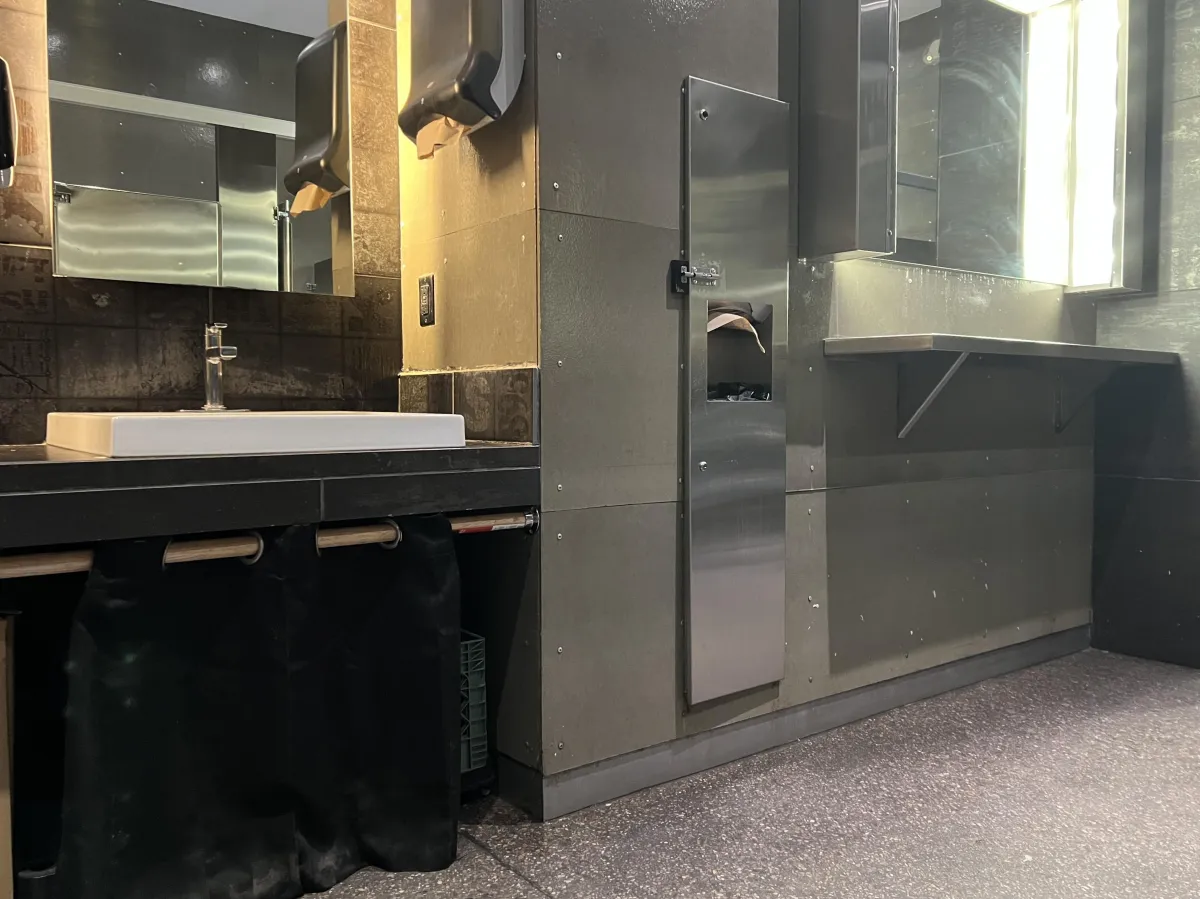
Schrödinger’s Sink
Series: Almost Accessible
This piece is part of the ongoing Almost Accessible series, where I name the quiet ways systems filter people out — not because anyone stood at the door and said “no,” but because the structure was built with someone else in mind. You can read more about the series on this page.
I was in a restaurant last week in Scottsdale, and after enjoying a genuinely lovely meal, I rolled into the restroom. The restroom is one of my quiet criteria for repeat business. I don’t announce it, but I notice. It tells me whether a place understands access as hospitality or as checkbox.
I drove straight to the back and found a wheelchair-accessible stall. It was large enough for me to turn around without choreography, which already puts it ahead of many places. For a moment, I allowed myself a small hope that I might get the full restroom trifecta — stall, sink, and the ability to wash my hands like anyone else at the table.
Sure, there was soap. Sure, the faucet had lever handles. Sure, the sink height technically worked.
The clearance underneath, however, was theoretical.
And yes, I realize that sounds absurd. Clearance under a sink should be binary. Either a wheelchair fits under it or it doesn’t. This isn’t quantum physics. We’re not talking about Schrödinger’s Cat. And yet the sink — a long, modern trough installation — had become convenient storage. Paper goods were stacked neatly underneath, hidden behind a curtain so the restroom still looked tidy. From a standing position, nothing looked amiss. From a seated one, the space simply didn’t exist.
I sighed in that familiar, low-key way that comes from recognizing a pattern and reached for hand sanitizer in my purse. Adapt. Compensate. Carry your own infrastructure when the building’s doesn’t extend far enough. That’s the routine.
And then I decided not to let it slide.
I asked the waitress if she could find the manager. I made sure to say we’d had a lovely meal and attentive service, because that was true. Then I asked if I could show him something. This wasn’t about reciting code requirements. It was about standing — well, sitting — in the space and letting the problem speak for itself.
He was apologetic. He said it would be remedied right away.
I believe him. I want to believe him.
Because this wasn’t a total failure of design. The stall worked. The sink had been installed at the correct height. Someone had measured. The architecture was almost there. And then someone else needed a place to store paper products, and the most convenient location happened to be the only usable clearance for someone like me.
That’s how almost accessible happens. Not through malice. Through small operational decisions that feel harmless until you’re the one affected.
I’ve seen this pattern before. When I was mapping restaurants in Scottsdale for Wheel the World, I encountered the same situation more than once. In one location, when I pointed it out, the manager told me there was nowhere else to put the supplies and that they would simply label the restroom as having no clearance under the sink. Relabel the limitation, and the responsibility disappears.
Except it doesn’t.
Being able to wash and dry your hands in a public restroom is not an “extra.” It’s basic hygiene. It’s the closing act of dining out. You eat, you excuse yourself, you wash up, you return to the table. Unless you can’t.
What frustrates me most is how close these spaces are to working. The dimensions are there. The intent may even be there. But somewhere between compliance and daily operations, access becomes negotiable. And that negotiation is invisible to the people who never have to wonder whether the sink will accommodate them.
A different operational choice could fix it. A different priority could make the space usable instead of theoretical.
Until then, every time I roll up to a sink, there’s a moment of quiet uncertainty. Will this one actually work, or is it another case of Schrödinger’s Sink — accessible in theory, inaccessible in practice?
Almost accessible doesn’t look broken. It just works exactly as intended, and that’s the problem.