When Accessibility Feedback Is Ignored
Series: Almost Accessible
This piece is part of the ongoing Almost Accessible series, where I name the quiet ways systems filter people out — not because anyone stood at the door and said “no,” but because the structure was built with someone else in mind. You can read more about the series on this page.
Dumfounded. Gobsmacked. I’m not sure exactly how to name it because it was something quieter and deeper than that. It was the kind of disorientation that settles in when you’ve done the responsible thing and nothing moves.
My husband was carrying our luggage from the hotel to the van, when he slipped at the edge of the sidewalk adjacent to the accessible spaces in the parking lot. It wasn’t dramatic. He didn’t go down hard. It was the sort of half-fall where you tweak your ankle, your body catches itself and you keep moving, a little startled, a little embarrassed. I was a little behind him, so couldn’t see the problem. It wasn’t until we were in the parking lot looking back that the problem revealed itself in that way subtle hazards often do: obvious once you know where to look.
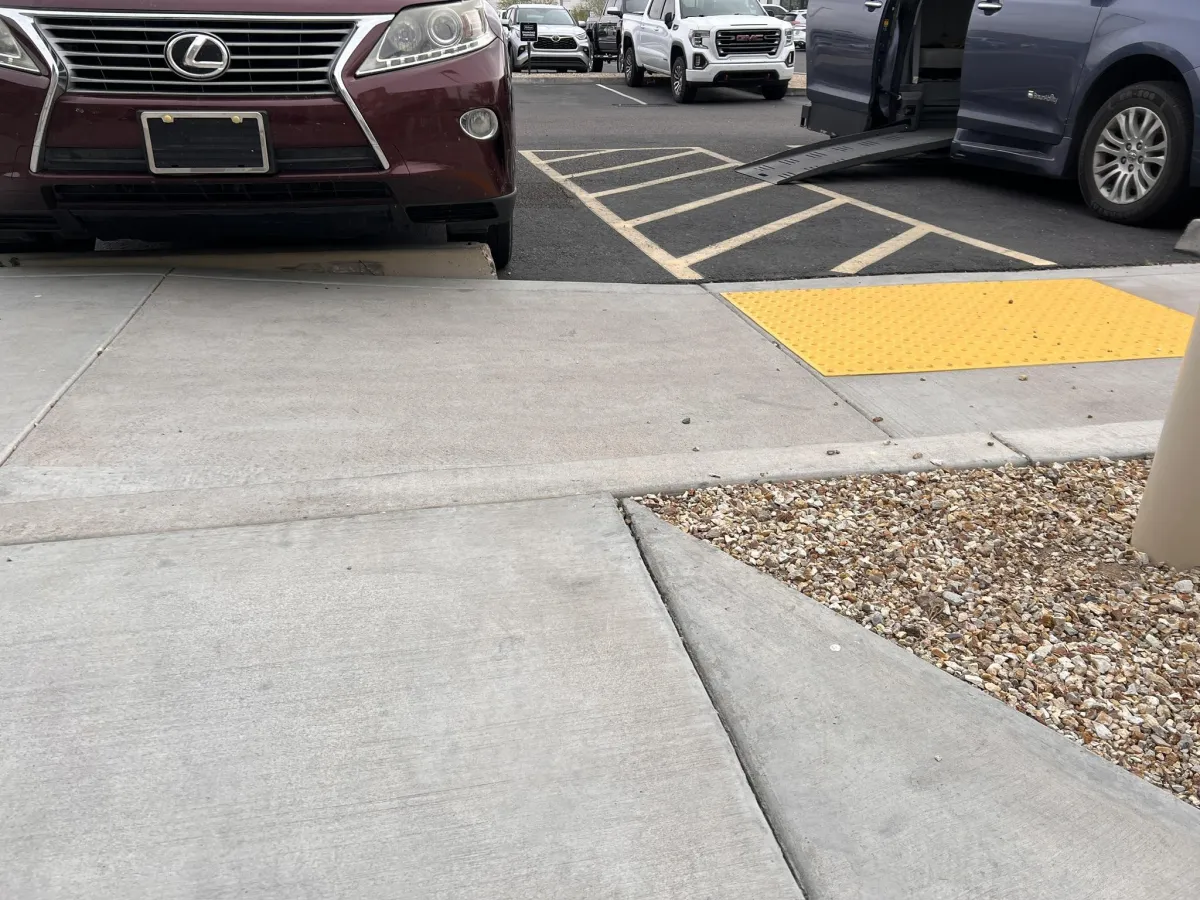
There was a curb drop between the sidewalk and the parking lot. Not a step your brain prepares for. Not something clearly defined. Just about an inch of elevation change. From the parking lot toward the hotel, the sun created a shadow line that made the drop readable. From the hotel side — where he was walking, arms full of luggage, expecting level ground — in flat light, the pavement blended into itself. The transition disappeared. There was no paint, no contrast, no visual cue that the surface shifted.
An inch doesn’t sound like much until it interrupts your balance. And what went through my mind immediately wasn’t only his stumble and the strain it put on his ankle, it was what my 450-pound power wheelchair might do on that same invisible edge. It could destabilize. It could send my body lurching forward and the jolt could jerk my hand enough to send the joystick someplace I didn’t intend to go. You don’t need a dramatic obstacle to create risk. You just need something subtle enough to hide in plain sight.
I checked that he was okay and then went back inside to find the on-duty manager. He came out with us, and by then the sun had shifted just enough to cast a shadow that made the drop easy to see. He nodded. While we finished loading the van, we saw that he had called the general manager out as well. They looked at it together. There was no defensiveness, no argument. It felt collaborative — like the kind of issue that would take someone in maintenance five minutes and a can of high-contrast paint to fix.
We left assuming it would be handled.
Seven weeks later, we returned because we wanted the hotel to work for us. It hit that rare combination of preferred brand, very good room setup, and centralized location that makes travel easier when you’re visiting family. The sidewalk transition was still there. Still about an inch. Still visible from one direction and nearly invisible from the other. Still unpainted.
No one had dismissed us. They had seen it. They had acknowledged it. And yet nothing had changed.
What lingers for me isn’t fury. It’s the quiet weariness of realizing that even when you offer useful, practical information — information intended to prevent someone else from getting hurt — it can simply evaporate into the operational fog. We weren’t critiquing design taste. We were pointing out a safety risk with an inexpensive solution. The kind of thing that protects both guests and liability exposure. The kind of thing you assume will move up the priority list because it is so easy to address.
Silence in accessibility work rarely looks hostile. It looks polite. You are thanked. You are assured it will be addressed. And then the hazard remains, waiting for the next person who approaches from the wrong direction in the wrong light, trusting the ground in front of them.
Not everyone will know to adjust their steps. We did, because we had already learned. We remembered. We compensated. But learning through near-misses is not a safety strategy.
Giving feedback takes energy. It means interrupting your own plans, finding someone in authority, and explaining what you saw and why it matters. It comes from believing that small corrections prevent larger consequences. When nothing shifts, you begin to understand how easily small risks remain small priorities — not because they aren’t real, but because they haven’t yet become expensive.
We stepped around the curb on our way back inside. It was still there, doing exactly what it had done before — blending in, waiting, and quietly insisting that “being on the list of things to be fixed” is good enough.
Almost accessible doesn’t look broken. It just works exactly as intended, and that’s the problem.